Shaun
Finnegans WakeShaun is the book’s changeable messenger: at once a postman in a dreamlike vision, a conspicuous traveler surrounded by admirers, and one of the divided brothers named alongside Shem. His arrival is staged through clothing, light, and the sound of his name; his departure through farewell, tears, and onward motion. The name does not settle into a single, stable identity: it recurs in a three-part formula of brotherhood and shame, and is also attached to a sleeping infant called Frank Kevin.
Identity and Introduction
Shaun first emerges in a nocturnal scene as a figure whom the dreamer hears before clearly seeing. Midnight bells and a faint sound from the church give way to a cry calling for Shaun to post the post. A wavering light gathers into the recognizable glow of his belted lamp, and the shadow becomes a well-dressed man. The scene makes the messenger’s arrival a transition from obscurity to vivid appearance, while keeping perception within the uncertain conditions of sleep.
His appearance is elaborately assembled from the signs of a formal, public self. He wears a fine coat, thick-soled shoes, a bright waistcoat, and conspicuously large buttons; an embroidered motto associates him with mail and payment. The passage lingers over his garments as if a postman’s authority could be read on his body. Shaun appears not merely as a carrier of messages but as a carefully dressed emblem of the role he performs.
The Postman and His Self-Presentation
The vision presents Shaun as a messenger entrusted with an extraordinary burden of letters. Yet his own account of the work is far from triumphant. He complains that he is worn out, sinks down exhausted, and describes himself as a humble mailman of peace rather than a figure equal to the honors and responsibilities assigned to him. The strain of carrying so many messages makes the official grandeur of his costume sit beside bodily fatigue and self-deprecation.
His speech also turns the scene toward kinship and resemblance. Shaun compares himself with an “other” who is his head and whom he loves, recalling that they shared a room and looked toward the same woman. The allusion makes their relation intimate but competitive: they are bound by likeness and shared experience, yet one seems to occupy the more prominent position. This personal comparison complicates the messenger’s self-display with an admission of attachment and rivalry.
Jaun’s Journey and Farewell
In the later episode, Shaun appears under the name Jaun, pausing at a weir to loosen his bruised shoes and rest his feet. The pause gives his journey a physical scale: the traveler has covered a long distance, and his footwear bears the cost. Though perspiring and still troubled by a numb foot, he is described as changed for the better and remains lively enough to continue. His progress is therefore neither effortless nor purely symbolic; the passage makes the body’s weariness part of the departure.
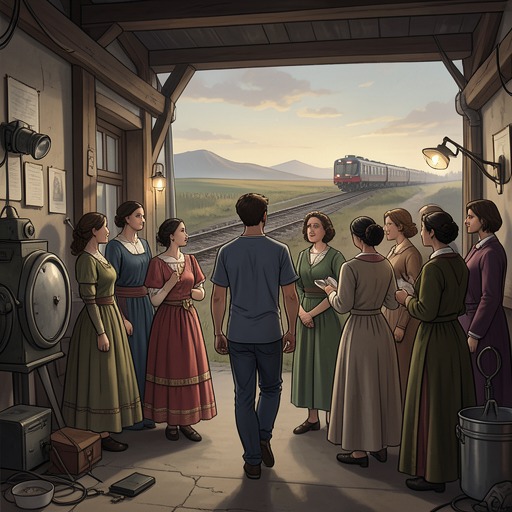
Twenty-nine young women from a national night school watch him beneath a tree. Their lesson and their gathering are interrupted by the sight of the traveler and by the snores of a sleeping figure nearby. Jaun becomes an attraction around which attention and praise collect, a public presence framed by the girls’ response. Their admiration is not quiet: they gather to cheer or curse him depending on whether he leaps or falls, and their collective excitement makes the farewell a spectacle.
After a prolonged leave-taking, Jaun turns abruptly to look back. He sighs, considers what remains to be said, and resumes speaking of prayer, heavenly reward, and the absence of earthly family quarrels in the world beyond. His farewell mixes solicitude with theatrical address: he blesses his listeners, jokes about parting, and offers spiritual consolation even as he prepares to leave. The speech does not erase separation; its elaborate promises make the impending absence more palpable.
Departure and Its Aftermath
Jaun’s final words become an announcement of movement away from his present company. He imagines himself traveling far from where he is, with no saddle or staff, borrowing a path as if it could give him wings. He bids farewell to the woman he is leaving and makes the brine his prospective bride, turning the journey into a new attachment to the sea. The language of flight and departure gives his separation a flamboyant, self-inventing character.
The watchers respond as if his departure were a crisis they could neither prevent nor fully interpret. Angels and admirers crowd around, prepared to cheer if he leaps or curse if he falls; attempts to get hands on him are repulsed. Jaun gives himself a sudden kick or prod that makes him sit up, while the young women answer with tears and clapping hands. Their response joins grief to celebration, turning his leaving into both a loss and a communal performance.
The scene closes without resolving the journey into a settled return. Jaun is seen going away, while the women wail and the narration calls the episode a favorable dream. His disappearance is thus registered through the audience he leaves behind: their sorrow confirms the force of his presence, but does not bring him back.
Brother, Double, and Unstable Name
The book elsewhere condenses Shaun’s relation to Shem into a three-part expression: Shem, Shaun, and the shame that divides them. Shaun is both a distinct brother and one side of an opposition whose bond remains inseparable from its fracture. The accompanying description of one as wisdom’s son and the other as folly’s brother makes the pairing less a settled genealogy than a compact play of contrasting roles.
The name also slips across generations and identities. In a scene describing twin infants, Frank Kevin sleeps on one side, blessing-like in appearance, while Jerry Jehu cries in his sleep on the other. The text identifies Frank Kevin with the bright, favored child and associates him with a future journey to America in search of paid work. Since Frank Kevin is among Shaun’s aliases, the adult messenger’s name is folded into the image of a sleeping child. That recurrence does not provide a conventional account of Shaun’s childhood; instead, it lets the name circulate between the traveler, the brother, and the infant, sustaining the book’s larger instability of identity.